It is not the first time to heard that Taiwan (Chinese Taipei) wants to bid Asian Games but the first thing came to my mind when I heard the news was ‘Do you think China will agree with you to host Asian Games?’
BUT
Firstly, besides China, this outside threat, we have to understand why Taipei needs to host Asian Games. There is a book which named ‘Start with Why’ which is my favorite book. Apparently, the main point of this book is to explain how important if people know their ‘WHY’ when they are doing something.
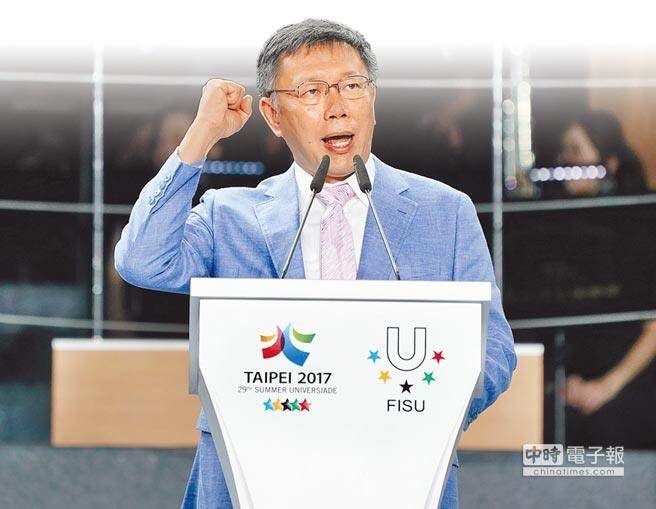
Taipei City Mayor Ko, Wen-je said: Taiwan should go global and should not be restricted to one place all the time. In my opinion, this “WHY" has strong power to inspire all Taiwanese that we need to host 2030 Asian Games and how this mega-sport event will benefit us. However, there are still some political issues on it.
I am not talking about China but the political issue inside of Taiwan. 2020 is the Presidential year and Ko is one of the candidates. This reason brought many argy-bargy right after Ko throw out this plan in the Taipei City Council.
Some of city councilors questioned Ko that Ko throws out this plan at this moment is for getting more supporters for the Presidential election next year.
I would say that it might be. But thanks to that I am still a PhD student in National Taiwan Sport University and the director of Taipei City Government Sport Department who is also a professor from my university, so I knew that the plan of bidding 2030 Asian Games is launched for few years.
Also, Taipei as the capital city of Taiwan which might be the best choice for hosting this mega-sport event to announce that Taiwan is still taking important part of this world.
Secondly, let’s talk about the international situation…or just the relation between China and Taiwan. Since Democratic Progressive Party (DPP) won the Presidential election in 2016 when the first female President appeared in Taiwan, China and Taiwan has stopped many communication paths, the example of it in sport, it’s the less communication between China Olympic Committee and Chinese Taipei Olympic Committee.
The former President of AIBA and International Olympic Committee Executive member Wu, Ching-Kuo said that we need not only to learn from the failure experience but also to seek China’s ‘understand’. So how to get China’s support (or permit?) is the most important thing to do if Taipei wants to get the hosting right of 2030 Asian Games.
According to the media report that there are at least six potential bidders for 2030 Asian Games: India, South Korea, Malaysia, the Philippines, Thailand and Uzbekistan.
India is the one of fastest economic growth counties nowadays but there is no enough infrastructure to host Asian Games, but it is still hard to say that because of the last year’s edition in Jakarta.
South Korea might be the best choice for the Olympic Council of Asia. With the success experience of Incheon Asian Games, South Korea equites with eligible conditions to host Asian Games.
If we consider that 2022 in China and 2026 in Japan, the future two year’s editions of Asian Games will be in North Eastern Asia, perhaps, Philippine and Thailand have stronger reason to be chosen as 2030 Asian Games because of the areas’ balance.
Honestly, I don’t have enough information about Uzbekistan, I can’t give comment on it. But let’s think of what the strength of Taiwan is and how we creat a affecting story to tell this world that we are ready to host this mega-sport event and not only we need it but also it needs us, needs Taiwan!

 透視運動產業 Sport Industry Inside